Average Frequency
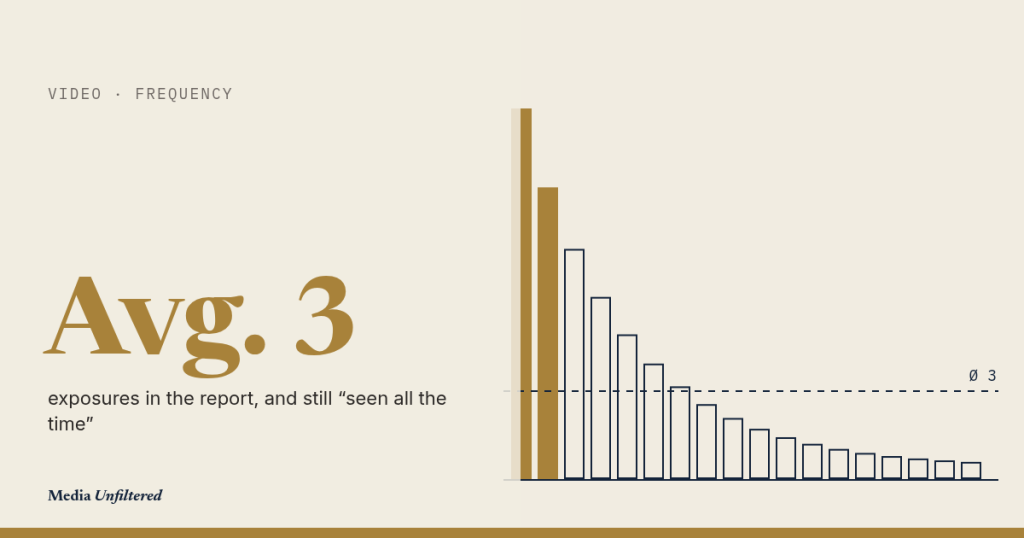
“I see your ad all the time.” The report for the same campaign says: average frequency 3. Both are true at the same time.
- An average frequency of 3 hides the fact that a few people carry a great many exposures.
- Frequency capping stops at the platform boundary. Nobody counts across all channels, and what gets counted is devices, not people.
- Too often and too rarely happen in the same campaign, from the same budget.
“I see your ad all the time.”
Probably everyone in the industry has heard this from an acquaintance at some point. Usually over dinner, usually with a slight note of reproach.
The report for the same campaign then says: average frequency 3. Both are true at the same time.
And that is exactly where it starts.
An average says nothing about how the exposures are distributed.
Ten exposures across five people can mean two for each. Or one each for four people and six for one. The report shows the same number, while the viewer experiences something completely different.
In practice, the distribution almost never looks like its average. A small share of users carries a large share of the exposures, and that share is usually the one that is cheapest to reach again.
No ill will required. An objective function is enough.
Then there is the problem of craft.
Frequency capping works in silos: the platform caps within the platform, the CTV provider within its app, the open market as far as an ID will carry. Nobody counts across all silos, because there is no common unit of count.
And even within the silos, we rarely count people. We count households, devices, browsers and logins. A household with three people and two TVs still shows up in the count as a single unit.
The second error is the quieter one. Too rarely. Anyone who makes reach the top objective spreads exposures thinly across many people, a considerable share of whom stay below any effectiveness threshold.
The uncomfortable part: both regularly happen in the same campaign, from the same budget.
That is why I consider frequency the most underrated question in converged video. Everyone talks about total video by now. But as long as each channel counts in its own currency, total video is a chart headline, not a plan.
That is exactly the subject of my masterclass on 12 November at 14:30 at ADZINE Connect Video in Hamburg. Title: Zu oft, zu selten, genau richtig. Frequenz im digitalen Bewegtbild. (Too often, too rarely, just right. Frequency in digital video.)
You don’t need to bring anything. At most the latest report that says average frequency 3.
This is an English version of an analysis originally published in German: Deutsche Fassung.

Ich bin Programmatic-Experte aus Wuppertal und schreibe über Mediaqualität, Daten und die Frage, wer am Ende die Optimierungslogik definiert.